


- August 24, 2026
Buying a thermal transfer ribbon starts with the printer, not the ribbon width or color. A TTO ribbon is mainly designed for thermal transfer overprinters on flexible packaging lines. A standard thermal transfer ribbon is more often used in barcode and label printers. Both use heat to move ink from a coated film, but they may differ in release behavior, backcoat, winding, dimensions and the way they run through the printhead.
The safest rule is simple: confirm the exact printer model, printhead type and material before choosing the ribbon.
What is a TTO ribbon?
TTO means thermal transfer overprinting. The system prints variable information such as dates, batch numbers, barcodes, ingredients and simple graphics on flexible packaging film or labels. It is commonly integrated with form-fill-seal machines, flow wrappers and other packaging equipment.
TTO printers can work in two modes:
- Continuous motion: the packaging film keeps moving while the code is printed. The printer and ribbon control must follow the line speed.
- Intermittent motion: the film stops during the machine cycle and the printhead moves across the print area.
A printer may support one or both modes. Print area, speed, ribbon length and handed orientation can change from one model to another, so the printer specification is part of every ribbon enquiry.
How is a standard thermal transfer ribbon different?
Standard ribbons are normally associated with desktop, commercial and industrial barcode label printers. They print on materials such as coated or uncoated paper labels, polypropylene labels and polyester labels.
Wax ribbons are widely used for paper labels. Wax-resin grades offer better durability on coated paper and many synthetic labels. Resin grades are chosen when the printed image needs stronger resistance to abrasion, chemicals, heat or outdoor exposure. The final choice still depends on the label surface and printer settings.
TTO ribbons often use wax-resin or resin formulations selected for fast release and good adhesion to packaging film. That does not mean every wax-resin ribbon is suitable for TTO. A flat-head label ribbon may look similar but run poorly in a near-edge packaging printer.
Near-edge, floating-head and flat-head: what do these terms mean?
Flat-head printing
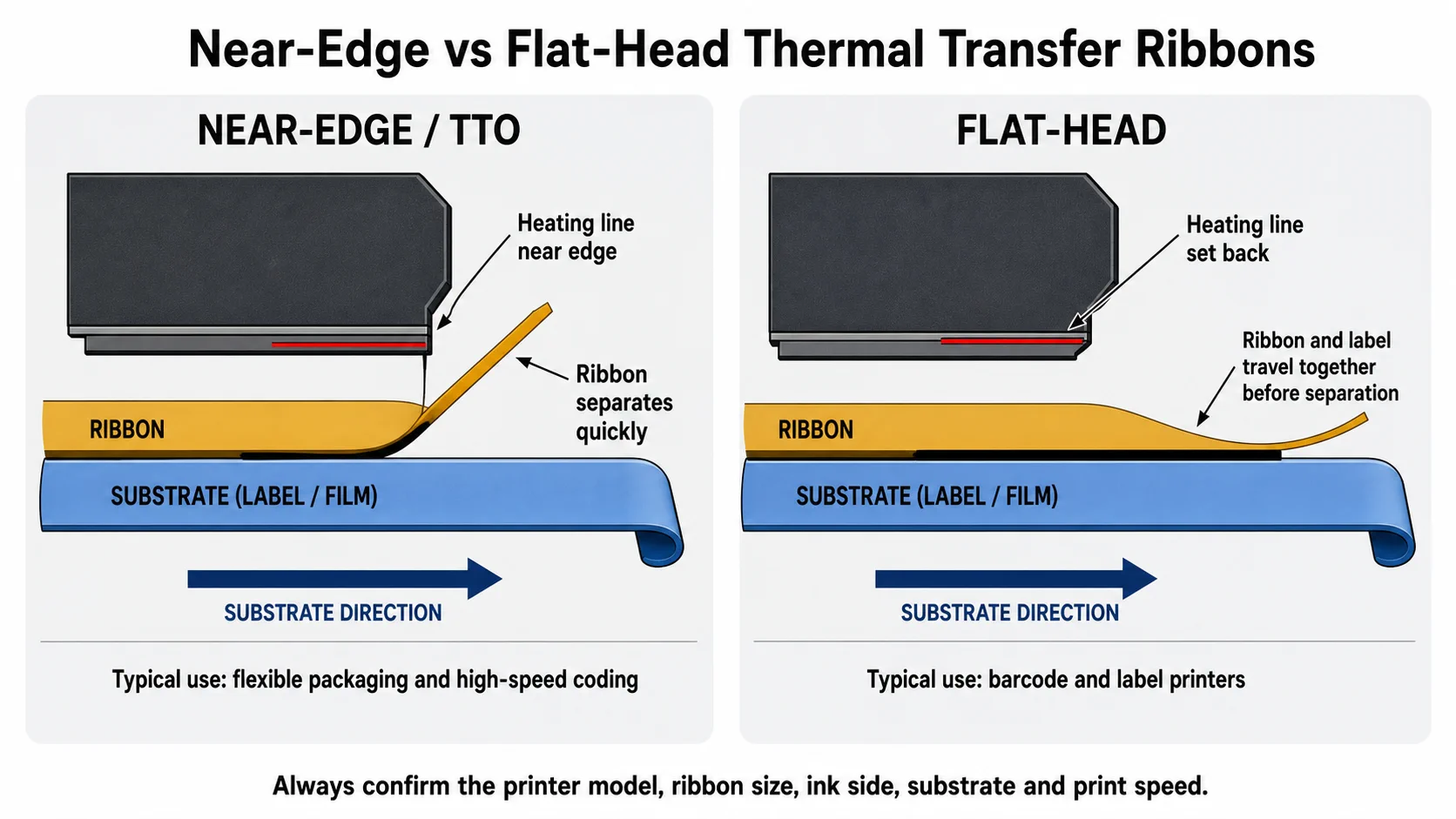
In a flat-head printer, the heating line is set farther back from the edge of the printhead. The ribbon and label stay together for a short distance after heating before they separate. This design is common in barcode and label printers and supports a broad range of wax, wax-resin and resin ribbons.
Near-edge printing
In a near-edge printhead, the heating line is close to the edge. The ribbon separates from the material soon after the ink is transferred. This quick release suits high-speed printing and is widely used in packaging-line TTO equipment as well as some high-speed label printers.
What about “floating-head” ribbons?
“Floating head” usually describes a printhead assembly that moves or maintains contact with the material during the printing cycle. In many supplier catalogues it is grouped with near-edge or corner-edge equipment. It should not be treated as a separate universal ribbon specification.
Near-edge describes the printhead geometry. Floating-head describes how the head assembly works. TTO describes the packaging-printing application. These terms overlap, but they are not interchangeable. Always ask for the printer brand and model before confirming compatibility.
Matching the ribbon to the printing job
Flexible food and consumer packaging
TTO is often the practical choice for printing dates, lot codes, barcodes and product information on flexible packaging. Confirm whether the film is PE, PP, PET, foil or a laminate, and whether it has a printable coating. A small production test is more useful than choosing only by ribbon grade.
Shipping, retail and warehouse labels
Flat-head barcode printers are common for paper and synthetic labels. Wax can be suitable for general paper labels, while wax-resin or resin may be needed for coated stock, handling resistance or synthetic materials. Buyers can review OceanLink’s thermal transfer ribbons together with the intended thermal label material.
Durable product and chemical labels
Resistance requirements matter more than the ribbon name. Share the label material, expected abrasion, cleaning chemicals, heat, moisture and service life. Resin may be appropriate, but it still needs to be tested with the exact printer and face stock.
What should a buyer confirm before ordering?
- Printer brand and exact model: do not quote only the print width.
- Printhead technology: flat-head, near-edge or the equipment maker’s specified TTO design.
- Machine motion: continuous or intermittent, including left-hand or right-hand installation where relevant.
- Ribbon dimensions: width, total length, core inside diameter and maximum outside diameter.
- Winding: ink side in or ink side out, plus any leader, trailer or notch requirement.
- Printed material: paper label, PP, PET, PE, foil or laminated film, including any coating.
- Code and speed: print area, resolution, line speed, cycle rate, barcode size and required darkness.
- Resistance: abrasion, heat, chemicals, moisture and storage conditions.
- Compliance documents: ask for the documents needed for the market and application rather than assuming one ribbon grade covers every requirement.
Common purchasing mistakes
- Ordering by ribbon width alone.
- Assuming every near-edge ribbon is automatically suitable for every TTO printer.
- Using a flat-head ribbon in a near-edge printer because both are described as wax-resin.
- Ignoring winding direction, core size or maximum roll diameter.
- Approving a ribbon on one label or film and using it on a different surface without testing.
- Keeping the old heat and speed settings after changing ribbon grade.
For a useful quotation, send the printer model, ribbon dimensions, winding direction, packaging film or label material, print speed and a sample of the required code. You can also contact OceanLink Paper to discuss sample testing and compatible ribbon options.
Quick comparison
| Point | TTO / Near-edge / Floating-head systems | Standard flat-head label systems |
|---|---|---|
| Typical equipment | Packaging-line thermal transfer overprinters and some high-speed label printers | Desktop, commercial and industrial barcode label printers |
| Main material | Flexible film, foil, laminates and selected labels | Paper and synthetic label stock |
| Printhead behavior | Heating line near the edge with quick ribbon release; the head assembly may move in intermittent TTO | Heating line farther from the edge; ribbon and label separate later |
| Production motion | Continuous or intermittent, depending on the printer | Normally indexed label printing |
| Common ribbon grades | Application-specific wax-resin and resin grades are common | Wax, wax-resin and resin |
| Key buying check | Printer model, motion mode, orientation, release behavior, film and line speed | Printer model, label stock, ribbon size, winding and durability |